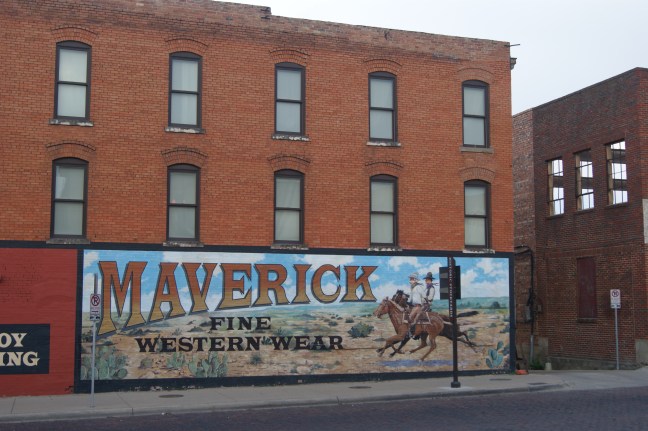
Mavericks are apparently named after Samuel Maverick, a Texan cowboy. Unlike every cattle owner of the day, he didn’t brand his cattle and let them wander about at will.
Perhaps he just couldn’t be bothered. It was too damn hot.
Mavericks are apparently named after Samuel Maverick, a Texan cowboy. Unlike every cattle owner of the day, he didn’t brand his cattle and let them wander about at will.
Perhaps he just couldn’t be bothered. It was too damn hot.
We headed down to Oklahoma from Tulsa early this afternoon, the final part of our piece of Route 66 on this trip. From here, the old road winds on to Amarillo (turns out pretty much everyone out here knows the way) and then New Mexico. Our plan instead is to head south to Dallas in a couple of days.
It’s been quite some day though.
First off, Oklahoma in late July is damn hot. At 2pm today it was 98 degrees, and no place for a pair of Scotsmen. After checking into the Isola Bella (which although meaning ‘beautiful island’ is a huge complex of self-catering apartments in the city), we hid in the shade for a few hours. (Cranking up the air conditioning in the Jeep, we then embarked on a ludicrous hunt for a same day dry cleaners to allow Ali to get a rucksack full of clobber he’d been carting around since mid-July laundered.)
Second, another new thing. Live baseball, a minor league game between the Oklahoma City Dodgers and the New Orleans Zephyrs. Until tonight, I’d never really ‘got’ baseball. It’s a peculiarly American thing, and unlike other US sports like Basketball and American Football, there’s no history of it even being meaningfully shown on TV in the UK. When I have seen it before, it seemed a bit slow, staccato, not especially exciting. The no promotion thing. And it goes on forever: the games themselves and the actual season (nearly 80 games a season).
I appreciate it more now though. It’s slow because – as I said earlier – it’s damn hot, even at 8pm. The games are actually pretty tactical: clipboards and iPads abound, serious old men cupping hands and whispering instructions in each others’ ears. And although a bit paunchier than other athletes, these guys can hit hard and run fast, albeit in a stop/starty kind of way.
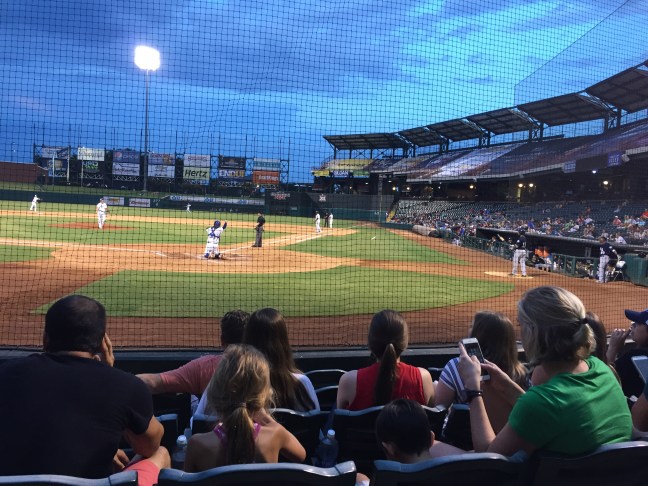
The atmosphere was great too. The Chickasaw Bricktown Ballpark stadium isn’t massive – maybe a 15,000 seater capacity – but it has facilities that would put all but the biggest soccer teams in Scotland to shame. Even this game tonight – there couldn’t have been more than 5000 people there – was a spectacle: the national anthem (obviously), cheerleaders, competitions, music, stuff for kids to do during the game and in the (many) breaks in play. And it was $20 to get in, for what could have been four hours entertainment. Calling it a community team might be going a bit far, but they take seriously the need to attract and keep whole families coming along to these games – often 30 or 40 home ties a year. We in the UK have a lot to learn.
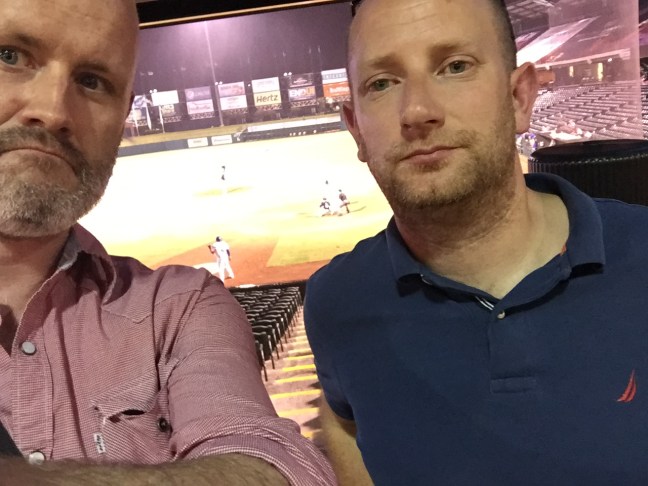
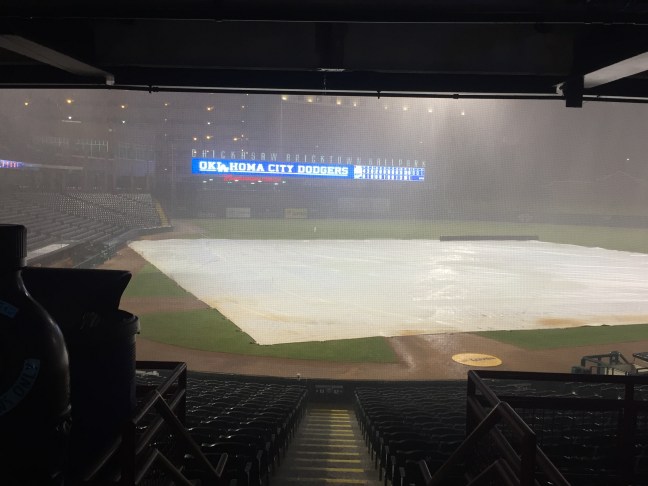
As it turns out, we didn’t get four hours of play tonight, Instead, we were treated to the most incredible thunderstorm and lightning I have ever seen and heard, which left the pitch waterlogged after just five minutes and play abandoned just after 9.30pm. Probably not surprising given the heat and that the city itself is in the middle of what is known as ‘Tornado Alley’ and its basketball team is the Oklahoma Thunder…
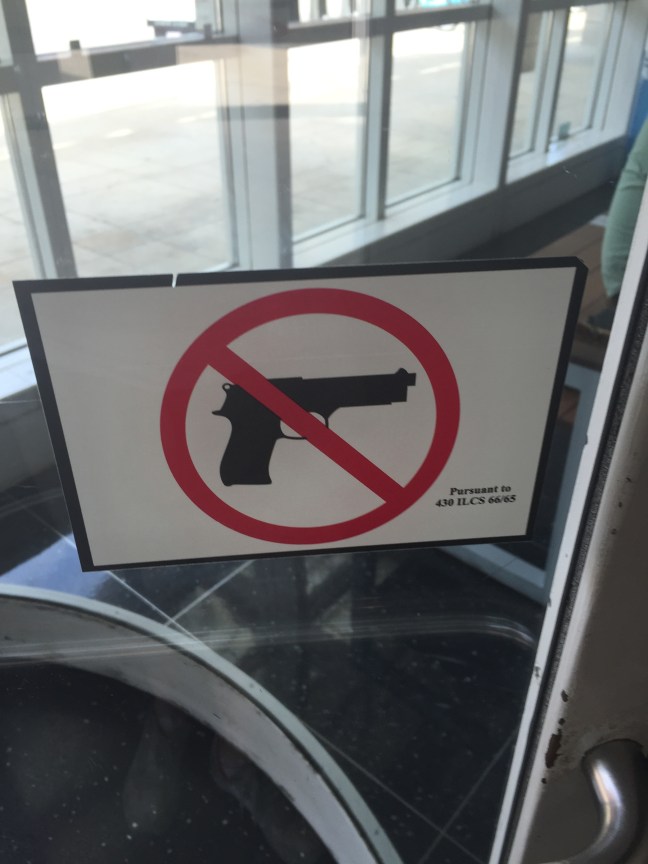
The final big event of the day happened just before the game. For the first time on this trip, I saw several, ordinary folk (baseball fans, paying punters in this case) openly carrying guns. On their hips, in holsters, tubby cowboys in business casual chinos. More than half of the states allow licensed open carry but – apart from seeing ‘No Guns’ signs in the Chicago Museum a week ago (see below) – the whole gun thing hadn’t really registered until today. Seeing guys walking into such a family-friendly environment, and with easy access to alcohol, is still a terrifying reminder that America is a really different place.
Ali and I left Independence, Missouri not long after closing time at the Harry Truman museum – and headed for state number 5 on this trip, Oklahoma. The next stop was actually the city of Tulsa; although it’s a sensible next stopping point on the route south, we chose it primarily so that we could bellow this song at each other all the way through Sunday.
The journey there was probably the most memorable thing about it.
We were way behind schedule and facing yet another 4-hour drive, the tail end of which would be in the dark. So I put the foot down a little, probably nudging 80 mph, on what we’re pretty clear interstate roads…
Within what could only have been about 15 mins into Oklahoma state itself, I saw the flashing blue lights of a police car right behind us and a clear instruction that we pull over.
The most annoying part was the lame theatre of it all:
…the pulling up behind our car.
…the internal car light going on.
…the purposeful removal of a handheld device from behind the visor.
…the two or three minute wait for any other movement.
…the silent thrust of “I’m in charge…”
I was shitting it though. Chris Dean had warned us that the police were overzealous in these parts and that they’ll dole out fines and penalties all day long.
As he approached, I was expecting a grilling, a heavy dose of sarcasm and a lighter wallet. I did exactly as I was told: answering his questions clearly and honestly, admitting I was in the wrong and apologising for what was only a few minutes of being over the speed limit. He asked for and got my driver’s licence and he strode off back to his car.
But it seems Eric (that was his name) and I had at least one thing in common: baulking at paperwork. I reckon my UK Driving Licence threw up a pile of chaos that his device or he simply couldn’t process without days of administrative bullshit. Within minutes he was back, telling us to slow down, don’t do it again and to take care….
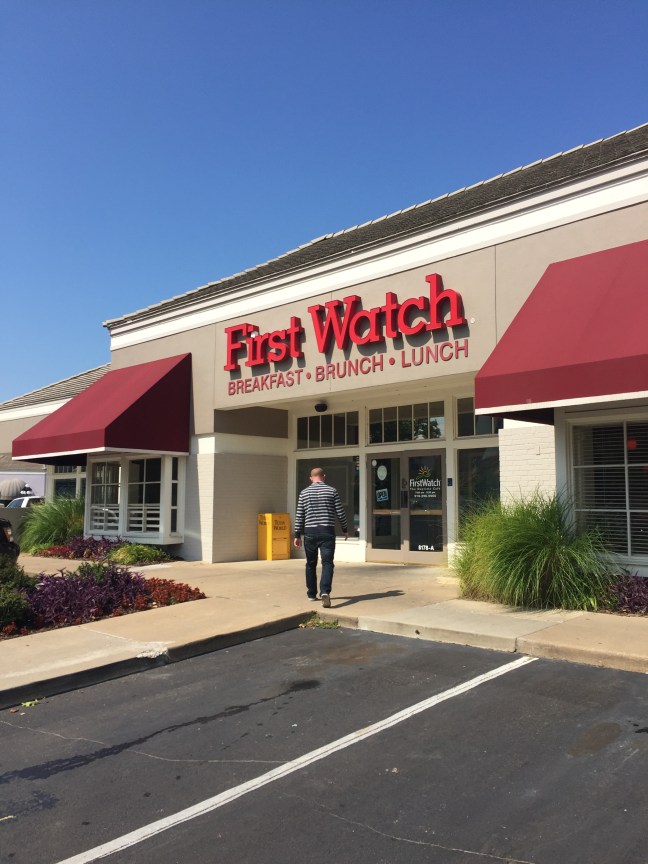
The following morning we spent a pleasant few hours wandering round the city of Tulsa. A decent breakfast at least, at the frankly fascistic sounding “First Watch”.
An ok lunch at ‘MainStreet’ (who the hell would call their business that?).
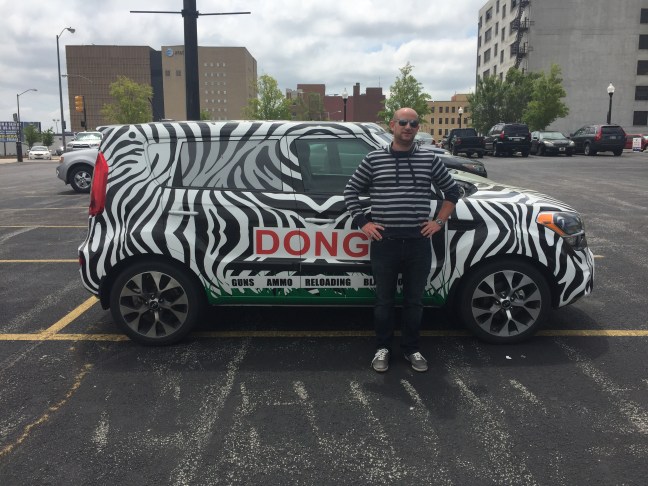
And in between those, spotting amusingly-spruced cars…
…and a trip to the Oklahoma Jazz Museum.
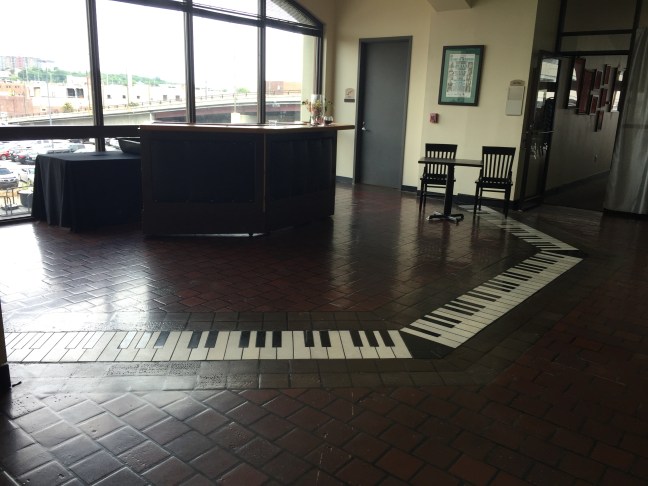
Some lovely bits and pieces and photos there, all honouring Oklahoman born musicians (not just jazz but blues and soul) and others who passed through.
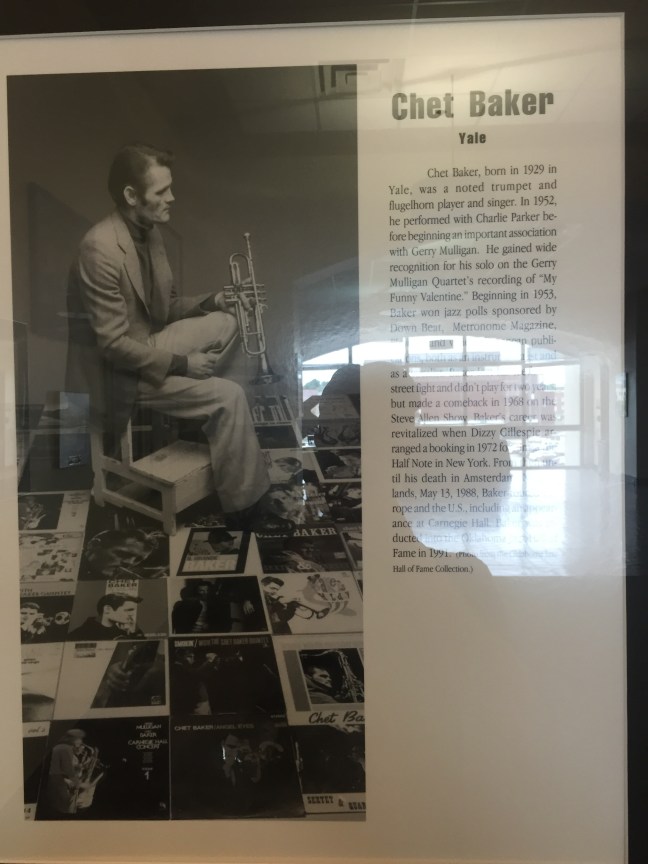
Like many of these towns and cities, Oklahoma and Tulsa were prisoners of geography – popular places because they were stopping off points between New Orleans and Kansas and then further north.
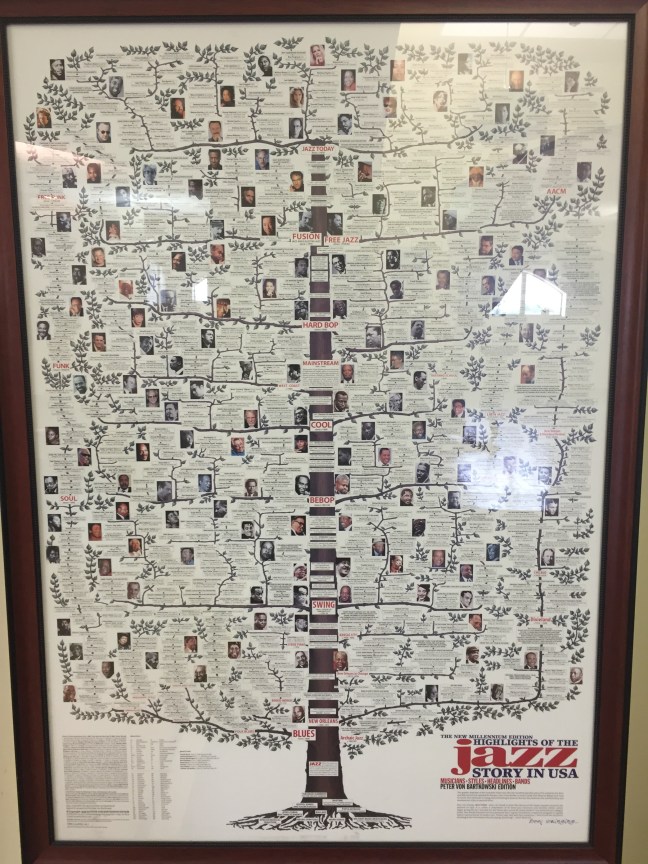
I really loved this fantastic Jazz tree, showing how this obscure black music at the turn of the last century defined what listened to for the next 120 years.
Today was pretty ridiculous. Owing to yesterday’s fuck-ups, we had a crazy agenda – trying to cram in two presidential libraries in two states (Kansas, then back to Missouri), and then head off to a third state (Oklahoma), and all on a Sunday. In total, we put 600 miles on the clock.
Still worth it though. 9 hours driving inevitably meant we probably rushed the two libraries – and certainly the second of them. But, as with the others (as of today, I’ve been to four of the 13 with possibly another three to do on this trip), they are terrific places to visit: brilliant educational resources about US and world history in the 20 century and not necessarily adulatory, fulsome tributes to important men.
(We did it a bit out of sync as well, going to see Eisenhower (1953-60) in Abilene, Kansas in the morning before heading across to Independence, Missouri for Truman (1945 – 1952).)
There’s a better setting for Eisenhower’s. Driving through the small town of Abilene, I felt like I was travelling through a replica of 1950s Kansas: a grid system, traffic lights at the end of every block, bungalow houses, sparse streets, a few general stores. His museum and library is in the town itself, but unobtrusively set back in a tree-lined park. It’s really nicely done.
There are four bits to it: his actual childhood home, an understated church/Place of Meditation which is his final resting place, a museum and then library.
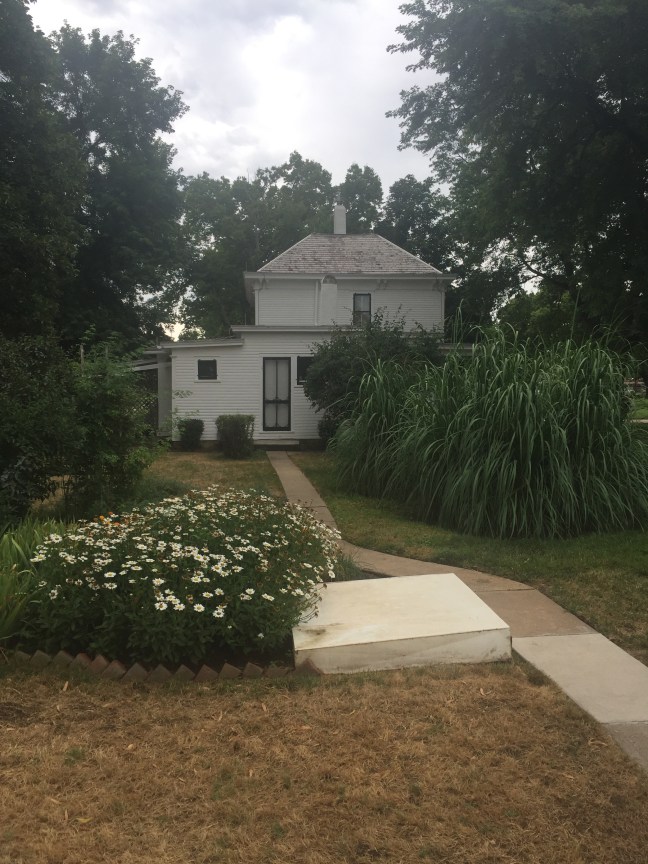
The childhood home is largely as it was in the very early 1900s, and the guided tour revealed something I didn’t know about him. His parents were members of the River Brethren, a branch of the Mennonite religion: among other things, they were known to be vigorous pacifists. That their son, 40 years on in World War 2, subsequently led the biggest land army the world has ever known would have taken parental disappointment to new levels…
The museum itself left me a little cold. Understandably, given his achievements as a soldier and five-star general, there is an enormous amount of space and time spent not only on his time in the military but on very detailed explanations of the lead-up to WW2, and none of it via multi-media or interactive means. Maybe two thirds of the place was given over to that stuff, and gave little to his childhood, his post WW2 life, his retirement and Presidency. I didn’t feel I got to know the man or what he had to face and address in his time in the White House. Since that period covered the Cold War and nuclear proliferation, the end of the Korean War, the beginnings of Vietnam as a problem for the US, an emerging space race, civil rights challenges and relative prosperity, it’s all a bit disappointing and not in keeping with what one expects of someone consistently voted in the top 10.
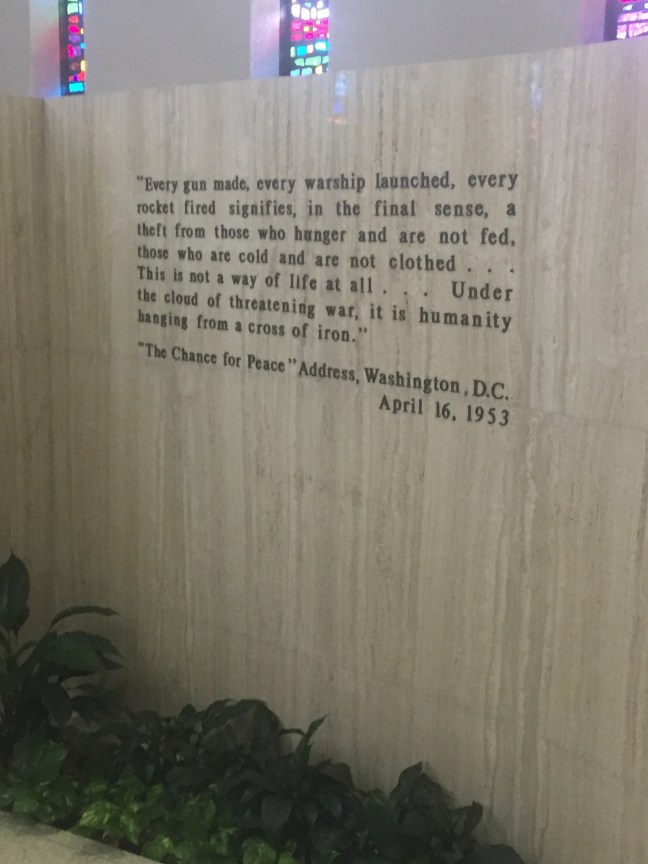
There are better indicators of his greatness near his final resting place, certainly through the statesmanlike quotes that adorn the walls there. One betrays his loathing of (and human of) the ‘Military Industrial Complex’:
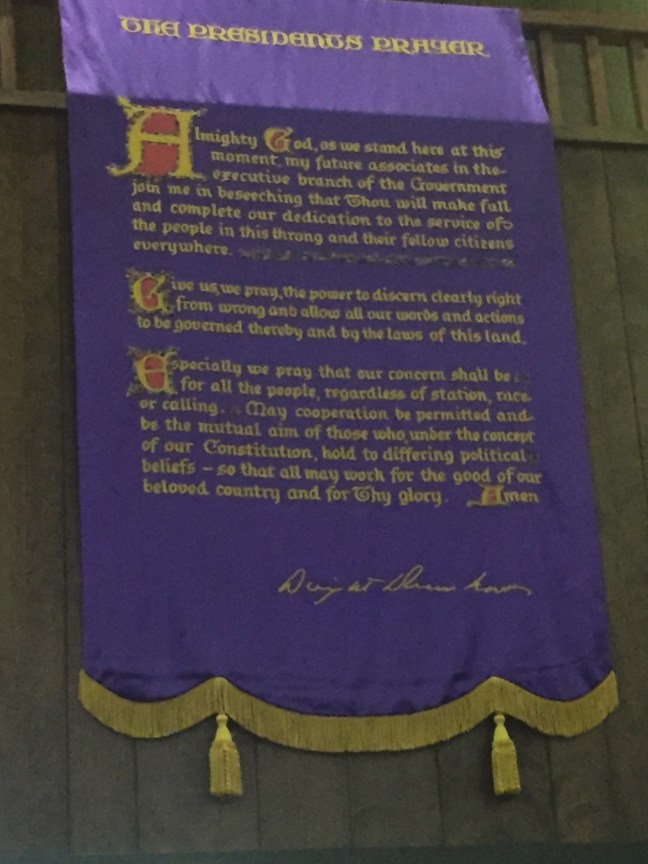
Another is his Presidential Prayer, which probably needs dusting off in election year 2016:
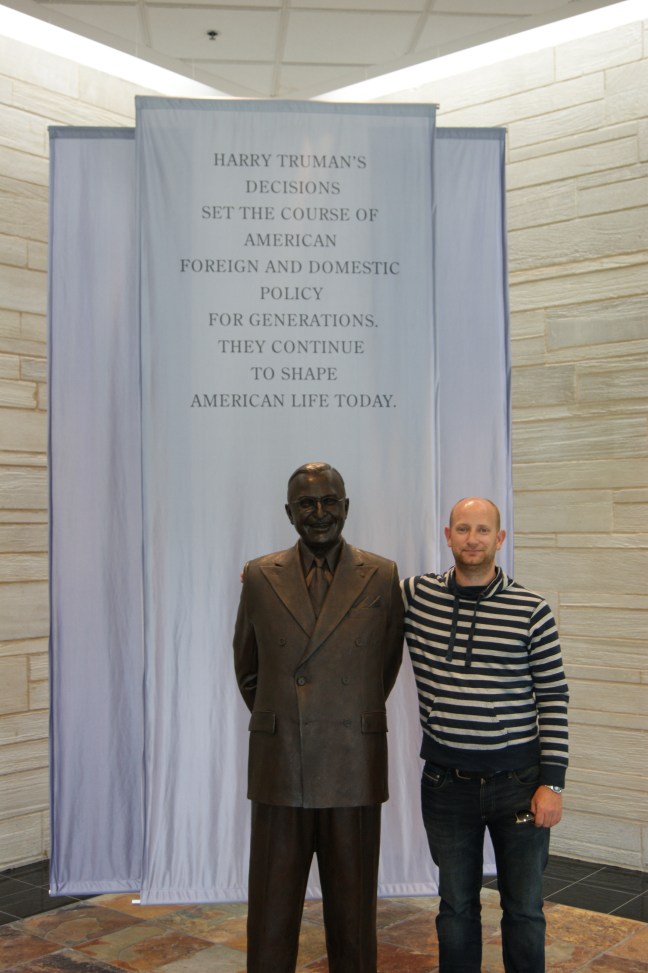
Harry Truman’s Library & Museum was much better. After hurtling across to Missouri again just after noon, we only had a couple of hours to spend there but it was a more satisfying experience. Certainly a more rounded picture: loads of his early life (including noting that his maternal grandfather was a slave owner), his almost reluctant entry to politics, a fair bit on his personal life. And really excellent exhibits of the presidential years: not just a linear walk through of pictures and quotes but thought-provoking, interactive sections regarding the often terrifying decisions he had to make.
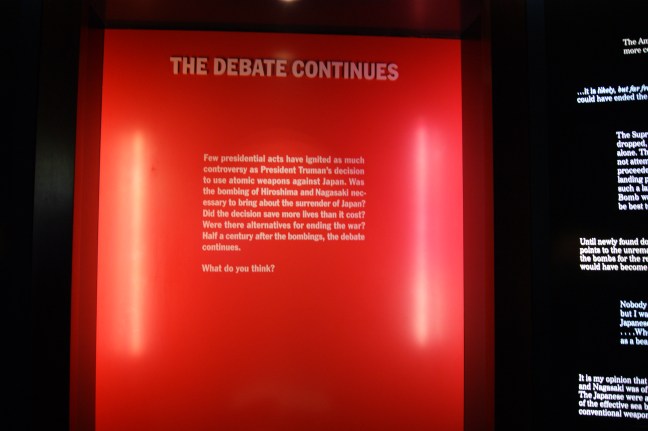
Obviously, there was lots on the decision to drop the Atomic Bomb (twice) but these were surprisingly balanced pieces, outlining criticism of his judgement on that and its implications. Even if you disagree with what he did on those things, you can’t help but feel sympathy and admiration for him. I think we forget that his time in office coincided with some of the most turbulent times in our history. He had to deal with the death of a much-loved predecessor in FDR; trying to end WW2; the early days of the Cold War; the fall of Berlin and the Berlin Airlift; the Marshall Plan to reconstruct Europe; the fall of China to communism; the beginning of the Korean Conflict. And against much opposition, he effectively had to sign off on the creation of the State of Israel.
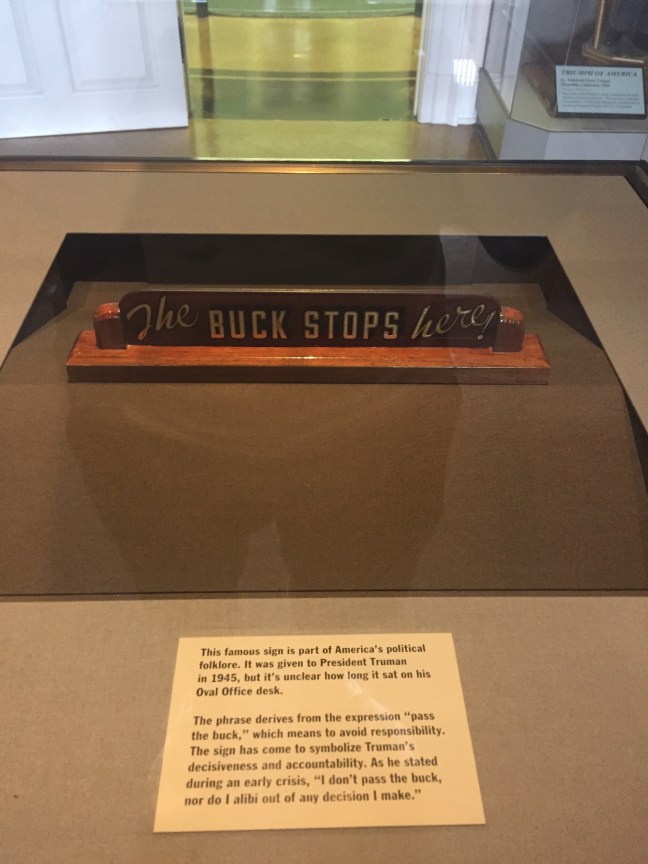
He made absolutely momentous decisions with long-lasting impact, and appeared to do so as a down to earth, fairly simple, occasionally prickly but humble man.
PS – I’ve mentioned the upcoming election a few times over the course of the past few weeks: it’s impossible not to reflect on it (maybe even obsess over it) when you’re out here. But it’s especially hard when you’re visiting places like these museums. You just can’t help but be impressed with the lives and achievements of the people who became President. My mate and travelling companion on this trip Al (a bigger Americanist than me, an MBA graduate of the University of Virginia) is of the view that all of them were exceptional people, by dint of just getting there. I have some reservations on that but I do think it’s easy to find something special in pretty much all of them, and in what they did when they got there.
This should continue after 8th November 2016. Certainly, the prospect of the first female President in the history of US politics is – this time, by its very definition – exceptional. But there is a lot more to admire about her as a candidate. In line with predecessors like Roosevelt, Truman and Eisenhower, she is serious, tough and clever and has a long track record of successful public service. She understands domestic policy and how the world works. Her temperament is sound: one feels safe with the idea of her in charge of the US military and its nuclear capability, appointing sensible Supreme Court judges, developing legislation, and working to reduce tensions around the globe.
Donald Trump is the opposite of all of these things. I heard last week on TV that his team at the Convention was insinuating comparisons with Eisenhower (mainly because the latter was the last non-politician elected). It’s utterly laughable in hundreds of ways. Someone so palpably inconsistent and incoherent on all his policy positions, who appears to have no core beliefs other than his own self-worth, who is unashamed by the douchebaggery of some of his support, who appears to have no interest or compassion for anyone less fortunate than himself (which is pretty much all of the US), and who has given very little to his country or communities other than periodic bankruptcies. I have a profound aversion to that Billy Big Bollocks, alpha male, swaggering CEO type that he so personifies. “Only I have the answer, only I can make things happen, the way ahead is simple folks’; there’s no room for nuance, hesitation, uncertainty.
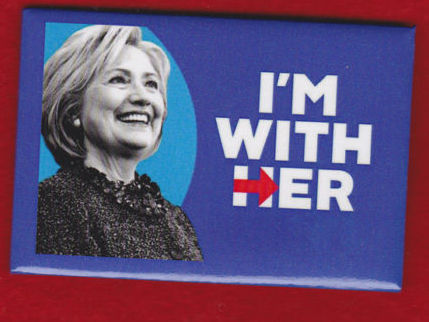
It’s not a slam dunk for Clinton. The polls tonight (25th July) suggest that Trump is ahead by a few points. Some of that will be a post-Convention bounce of course but the likelihood is that it will still be a relatively close result. Our taxi driver in St Louis the other night was convinced that Trump will win mainly because people dislike Clinton more. All we’ve seen in Kansas and Oklahoma so far are ‘Trump’ banners and car stickers. That might not be too surprising in the South but I heard the same in supposedly more liberal New York and Connecticut. I don’t pretend to know why but I suspect it’s mix of things: contempt for ‘establishment’ Washington figures, overfamiliarity, constant innuendo and conspiracy-mongering, simple tribal politics and – plainly – outright misogyny.
And yet, I’m still confident that it will be alright. The electoral math(s) are with her: the idea that Trump will do well with Latinos, African Americans, Muslims, any immigrants, the disabled, women and hundreds of other sections of American society is just not credible. And nationally, he has to win over several of the big states like Ohio, Michigan, Colorado, Virginia and Florida – all won by Obama in 2012.
But more than that I just have faith that overall they’ll get it right again. And elect the exceptional candidate for (probably) the 45th time in a row.
I didn’t know anything about Gene Clark until 1993, which was well after I’d fallen hard for The Stones, The Beatles, Neil Young and (ironically, given he was a founding member) The Byrds. That year, Teenage Fanclub released their Thirteen LP. While it’s a pretty shambolic self-produced record, it has some terrific songs on it – including one called, simply, Gene Clark. (It has another called ‘Fear Of Flying’, which I worked out later is probably also about Gene).
I’d be lying if I said I immediately became a huge fan of his. In those days, I was much more in thrall to Gram Parsons, another ex-Byrd. It was an immediacy thing I think: Parsons’ music with International Submarine Band, the Flying Burrito Brothers and finally with Emmylou Harris was simpler, sweeter and catchier than Clark’s.
Or maybe – to those teenage ears – it was that Gene’s songs are just so much sadder. Not just compared to Gram’s but to almost any other songwriter since the 60s. Because in the subsequent years that I’ve grown to love Gene Clark, I hear him as a ‘mature’ voice. No one else wrote or performed songs so drenched in melancholy, grief, self-doubt and confusion. His masterpiece, the 1974 LP No Other is musically lush and expansive (with huge slabs of country, folk, jazz, gospel, blues and prog rock: I’ve always thought the title track sounds like a lost Sly & The Family Stone classic). But emotionally it’s absolutely the equal of Neil Young’s Tonight’s The Night; the sound of a man falling apart.
He was the equal of any of his peers. His early Byrds stuff is pop dynamite: see ‘She Don’t Care About Time’, ‘Feel A Whole Lot Better’, ‘The World Turns All Around Her’. ‘Eight Miles High’ and ‘Elevator Operator’ are as good as any mid-60s Beatles. ‘So You Say You’ve Lost Your Baby’ and ‘Echoes’ every bit as haunting as that weird baroque period of the Rolling Stones in 1967.
And all of them beautifully desolate.
From the late-60s onwards, he went on to make many brilliant records but (just like Gram Parsons) with no real commercial success. He spent most of his post-Byrds career and life in relative obscurity, and struggled with several drug and drink addictions that eventually killed him in May 1991.
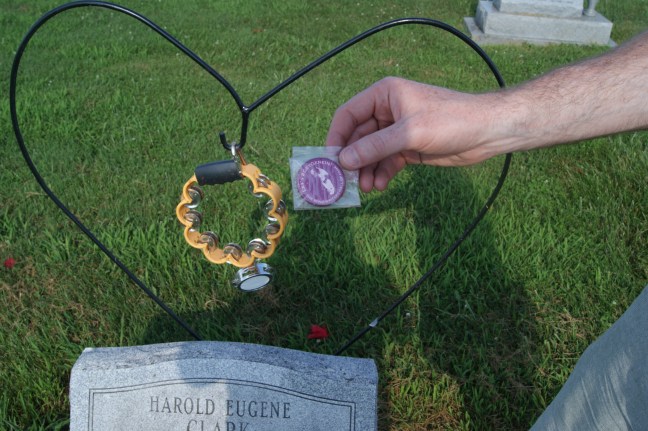
25 years after his passing, I wanted to pay my respects at his grave in Tipton, Missouri (the reason for yesterday’s minor balls-up). There’s no hoo-ha, just a relatively simple gravestone with his full name Harold Eugene Clark and the title of his most famous solo record. It’s all in keeping with the sleepy, un-showy town of Tipton itself.
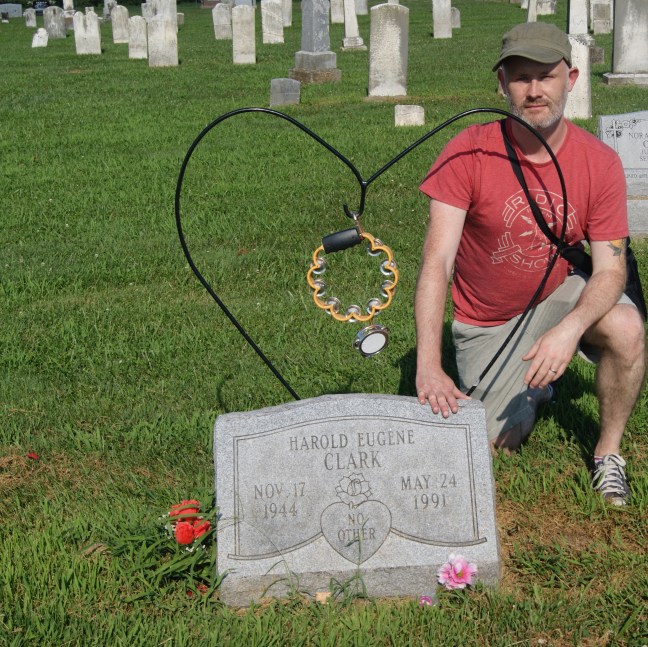
Incidentally, there is a worthwhile campaign to get Clark inducted into the Songwriters Hall Of Fame. I was going to leave a badge there but was chuffed to see there are already quite a few of them around the plot anyway. Hopefully, that’s a sign many others feel the same way.
Finally, it’s worth plugging a documentary film about Clark that came out a couple of years ago: “The Byrd Who Flew Alone”. An evident labour of love by its creator Paul Kendall, it is an excellent introduction to Gene’s life and music. Among other terrific moments and surprises, there’s footage of Clark singing ‘Silver Raven’ from the No Other LP in the late 70s.
But be warned: the ending is really, really sad.
Just like all of his songs really.
Chris Dean is my brother-in-law’s brother. He left Brechin for the States to become a soccer coach many years ago, and has since settled down there with a wife and four young kids. When I saw him at his brother’s/my sister’s wedding a couple of years back, we hatched a plan that I’d swing past Kansas whenever I did this mid-life crisis road trip.
To be fair to him, I didn’t give him much notice when I actually firmed up an itinerary. But when I said I’d be in town next Saturday, he explained that he wouldn’t be able to “tear it up” with us that night but he was adamant that we’d be more than welcome to join us at a pre-arranged family party…
His own brother-in-law’s wedding.
Shamelessly, we turned up anyway. Two tired, irritable and ill-dressed Scottish strangers, at least a couple of hours late. Predictably, we were welcomed warmly by the whole family, all delighted we were there, all thrusting beer and wine into our hands and all keen to know what the bloody hell we were doing visiting Independence, Missouri on a random Saturday night in July. That was especially true of the young couple, who couldn’t have been more accommodating and hospitable on their own big day. The very best of America.
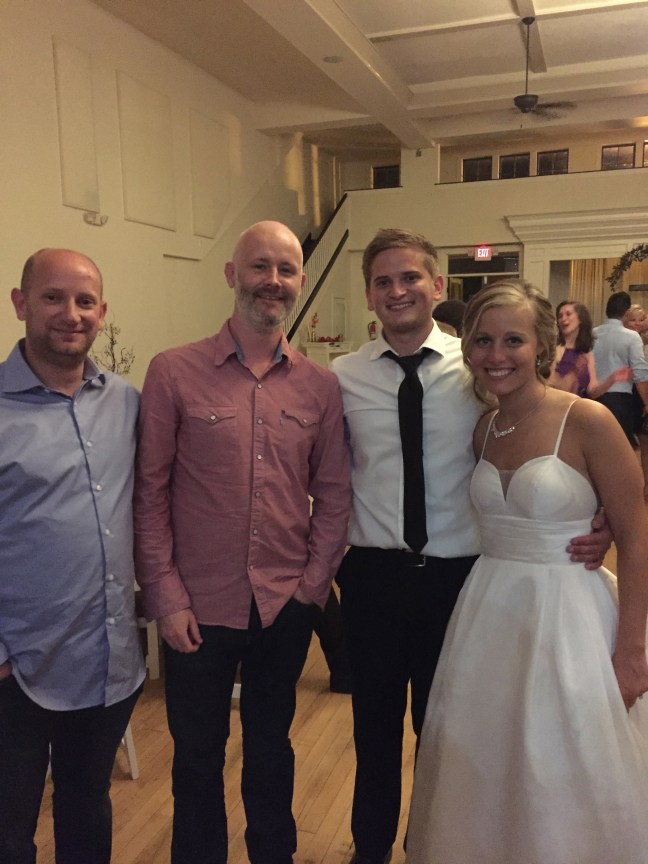
To Max and Maggie Engquist: wishing you both a long and happy marriage.
St Louis to Kansas City today, and a packed agenda. The aim was to nail the 250 miles in three and a half hours, with a couple of stop-off activities on the way.
I managed to balls it up in at least five ways.
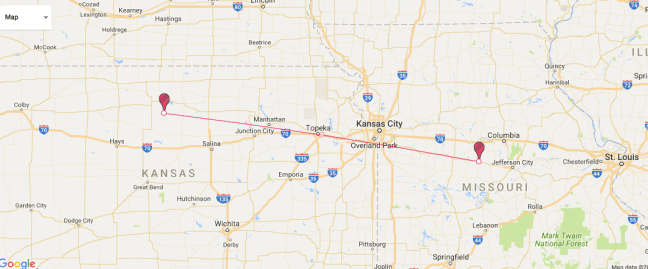
Tomorrow isn’t looking any less hectic either now.
A final piece from St Louis.
I remember as a kid in the mid-1980s, Channel 4 showed American Football in the UK for the first time. And they did it well, introducing Brits to stars like Dan Marino, William ‘The Fridge’ Perry and Joe Montana and to (then) iconic NFL teams like the San Francisco 49ers, the Dallas Cowboys and the Miami Dolphins. My favourite was Marcus Allen, who was at his peak in 1984, winning Super Bowl XVIII for the Los Angeles Raiders against the Washington Redskins.
The LA Raiders became my NFL team largely because of Allen, and I followed them as much as that was possible in those pre-internet days, made much more difficult when Channel 4 stopped showing NFL later that decade.
What I do remember though was how perplexed I was when I did get access to the new World Wide Web in 1995 and reading that the LA Raiders had become (in fact, had reverted to) the Oakland Raiders.
While I was confused by the franchise system in US sport 21 years ago, the good folk of St Louis appeared to have benefited from it that same year. In 1995, the Los Angeles Rams moved to St Louis and initially did very well: a win in Super Bowl XXXIV and another appearance two years later in 2001, but thin times followed in the years since.
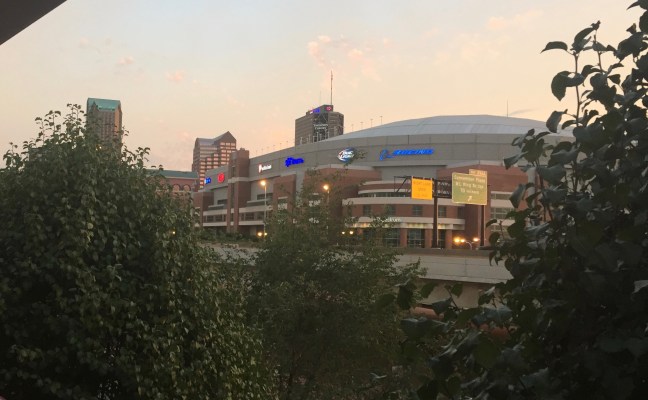
Things got considerably grimmer in for the St Louis Rams in 2016 though, when owner Stan Kroenke (also de facto owner of Arsenal FC) filed for relocation to the Los Angeles area for the 2016 NFL season. Although citing considerable frustrations with St Louis City authorities on redevelopment of the stadium, the reality is that the media and commercial rights available in LA and the wider California far outstripped that of St Louis and Missouri.
None of this is particularly new. But having wandered round a bit of St Louis and seen the former stadium, it’s not difficult to put yourself in the shoes of the erstwhile St Louis Rams fans: “What do you do when your team just disappears?”
There will be people in St Louis who have followed that team since 1995; some of them in their mid to late 20s and others who are just kids – all of them are now without a team they can identify with or watch in person or on local TV. Many of them will have coughed up thousands of dollars in that period; some of them experienced real joy at their Super Bowl appearances, more of them will have shed tears of frustration at their lack of success in the subsequent years. They – and a wider community in St Louis and Missouri – now have nothing.
They certainly won’t support the new franchise, the LA Rams. It’s unlikely they’ll opt for the nearest neighbours the Kansas City Chiefs (despite their recent success) or the Chicago Bears. They may instead give up football, American style, period.
Al and I spent just a few hours in St Louis on Saturday morning before heading off to Kansas. The bulk of that time was spent around the Jefferson National Expansion Memorial, which among other things marks the starting point of Lewis & Clark’s Expedition and the subsequent Louisiana Purchase in the early 1800s. The main feature is the spectacular Gateway Arch, probably now the most recognisable icon of the city, but of more interest to us (especially on a really humid morning) was the Old Courthouse.
Like many of the state or federal buildings here, it’s built in a classical style: with four distinct wings and an impressive cast-iron dome reminiscent of St Peter’s Basilica in Vatican City or St Paul’s Cathedral in London.
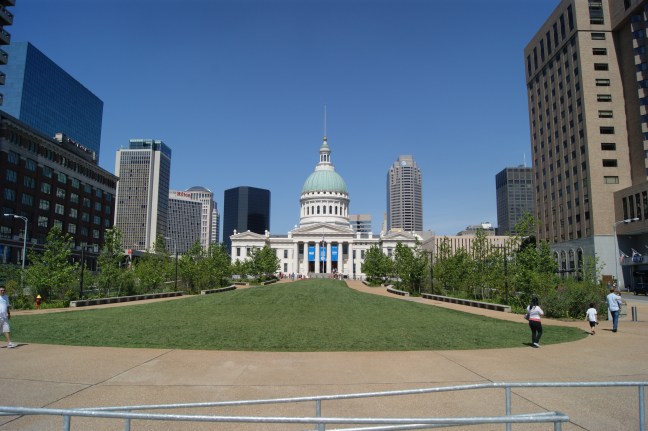
Inside that dome, in the courthouse rotunda, there is a fascinating museum setting out a useful history of St Louis and the state of Missouri more generally. Inevitably, that history very soon alights on what is a national story: the role of slavery and the battle for human rights.
At the centre of the story here is that of Dred and Harriet Scott. In 1846, they entered this Courthouse to sue Irene Emerson, who claimed to own the Scotts and their children, for their freedom. The case took 11 years to conclude, going all the way to the Supreme Court in 1857. The Court’s majority verdict – ruling against the Scotts on the grounds that since they weren’t citizens they couldn’t sue – caused outrage locally, nationally and internationally and was a major contributor to the Civil War just a few years later.
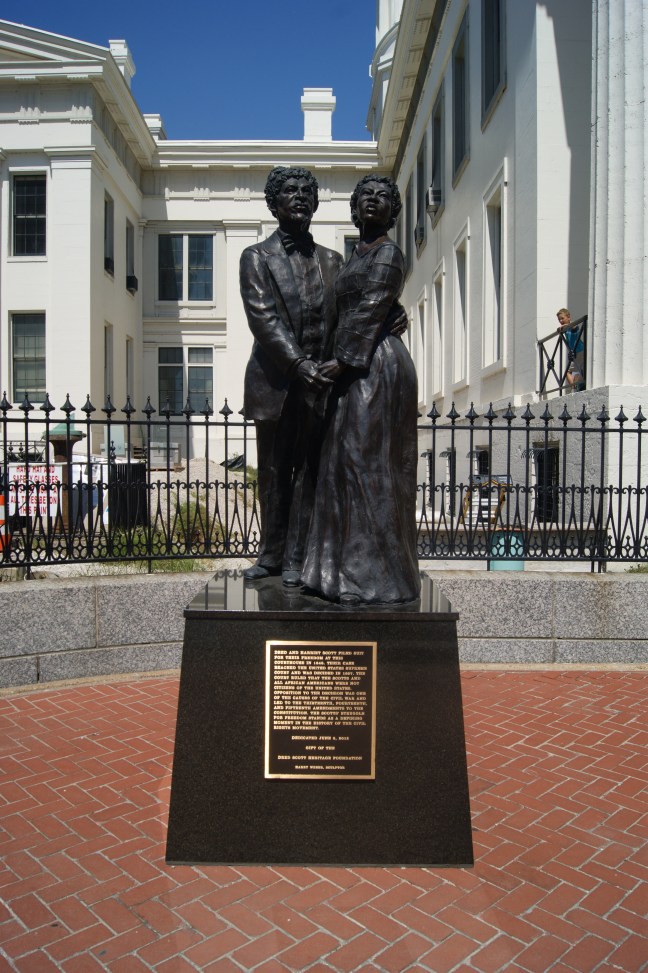
It’s a cliché to say that the fight didn’t end with the Civil War. And it didn’t end 100 years after that with the Civil Rights legislation of the 1960s. And it’s far from fixed even now. Literally just a few miles from where this statue stands is Ferguson, where in late 2014 and again in August 2015 a wave of protests and riots broke out in response to the killing of Michael Brown by Darren Wilson and the latter’s subsequent acquittal. Those events led to lengthy and heated discussions about the relationships between the (armed) Police and African Americans, the Use Of Force Doctrine locally and the significant racial disparities between the Ferguson Police Department and the people living there (a population that is two thirds black is served by a police force that is 90% white).
It’s just as clichéd and trite to say then that the US has a long way to go. But when one of the Presidential candidates in 2016 actively whips up suspicion and fear about Mexicans, other Latinos and Muslims and is painfully slow about disavowing the support of a proudly racist arsehole like David Duke (!), the worry is that it’s going backwards.
On Friday afternoon, Al and I set out on the first leg of the road trip proper: Chicago to St Louis, part of historic Route 66. Unlike the famous song, which fair rattles along, our experience was a massive pain in the balls. It took nearly 7 hours overall, in what seemed like rush hour traffic at both ends. Still, we were on our way.
St Louis was always on the list of places to visit. One of my friends from University, Helen, lived in St Louis for a while and made it sound (20 years ago at least) pretty exotic. I’m pretty sure she told me then about the 200m tall Gateway Arch, commemorating the city’s role in westward expansion. I knew that Budweiser is made there. And although my baseball knowledge is poor, I did at least know that the Cardinals are one of the most successful ‘franchises’ (shudder) in recent history with a couple of World Series wins in the past decade.
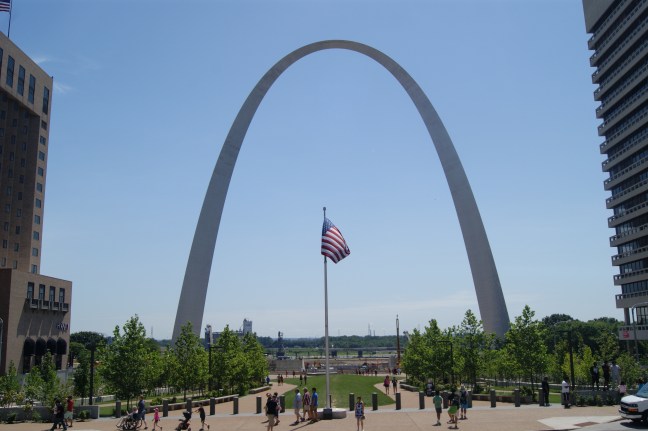
But the real reason, the only reason, was to pay homage to the place that made Chuck Berry. I often thought it significant that he was born and raised in that ‘Gateway’, a (supposedly) short distance to Chicago and the North, near the Mississippi river that so personifies independence, escape, freedom and adventure.
Everyone knows and loves at least one, probably several, Chuck Berry songs. Subconsciously, I’ve adored him since 1985. Like any kid growing up in that decade, one of my core memories is Michael J Fox performing “Johnny B. Goode” at the ‘Enchantment Under The Sea’ dance. (I saved up a shit ton of money in my late 30s to buy a guitar just like that one.)
That song is flawless. Despite being nearly 60 years old now (it was recorded in Chess Studios in 1958), it’s still crisp, it still sparkles, it’s still exhilarating. That dizzying intro, drums that positively thud, a pounding bass line, the boogie guitar rhythm, gorgeous tinkling piano and he’s totally yelling the words. And not just any old words: but a story. A country boy from Louisiana (originally ‘coloured boy’, changed for commercial reasons) leaves his ‘log cabin made of earth and wood’, and heads out to become a famous musician, carrying his guitar in a ‘gunny sack’, sitting ‘beneath a tree by the railroad track’, ‘strumming with the rhythm that the drivers made’. Not only is it the quintessential rock and roll tune, it’s a prize-winning novel, nailed in just over two and a half minutes.
So culturally significant is “Johnny B. Goode” that it was one of a very select few tunes dispatched into the far reaches of space on board the Voyager Spacecraft in 1977. Then US President Jimmy Carter wrote: “This is a token of our sounds, our science, our images, our music, our thoughts and our feelings”.
But most of his initial hits in the late 50s and early 60s could have been sent out there. They’re pretty much all solid gold, all characterised by exquisite lyrics, a virtually unique guitar style and infectious energy: “Maybelline”, “Sweet Little Sixteen”, “Carol”, “Memphis”, “No Particular Place to Go”, “Let It Rock”, “Roll Over Beethoven”, “Brown Eyed Handsome Man”, “You Never Can Tell”, “Too Pooped To Pop” (my kid’s favourite). On their own, these performances would have been significant: that they were then covered and copied by Elvis Presley, The Beatles, The Beach Boys, The Rolling Stones, The MC5, Jimi Hendrix, The Animals, Bruce Springsteen and David Bowie make them the foundation of pop music as we know it. Chuck Berry created a culture.
He himself isn’t perfect – far from it. He’s done some grim things in his time, some unforgivable and a couple of which meant prison sentences and shady financial settlements, even as recently as the 90s. Separating a person from his or her art is increasingly a challenge these days…
Anyway, Al and I only had a few hours in downtown St Louis tonight. We headed quickly to the Delmar Loop area, a strip of restaurants, shops and clubs that includes the Blueberry Hill bar, where Berry has played hundreds of shows in the past 20 years. It’s perfectly pleasant, with a Hollywood style walk of fame for notable St Louis residents of the past (including Miles Davis, Scott Joplin, Yogi Berra, William Burroughs, Tennessee Williams).
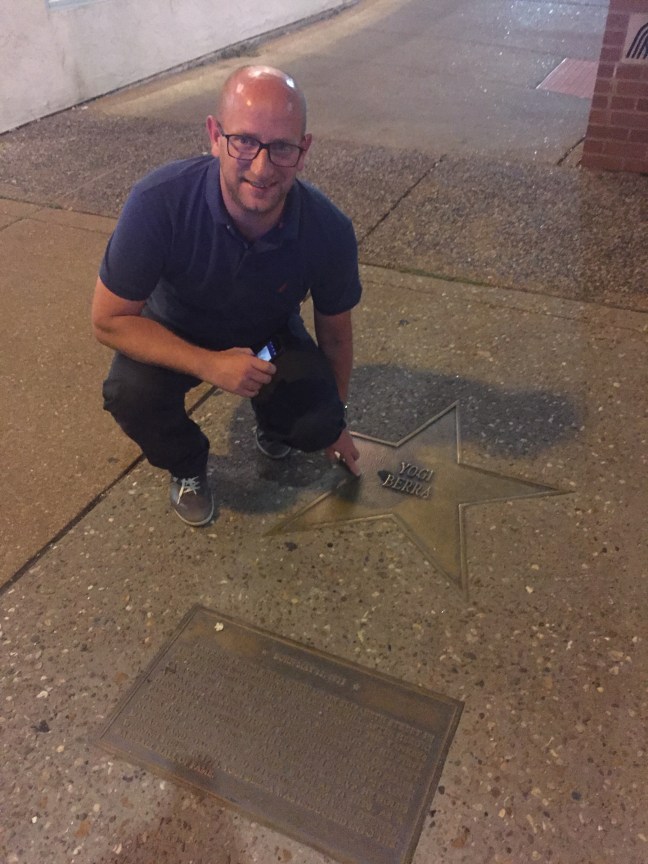
At the end of that walk is the Chuck Berry statue, commissioned and unveiled in 2011.
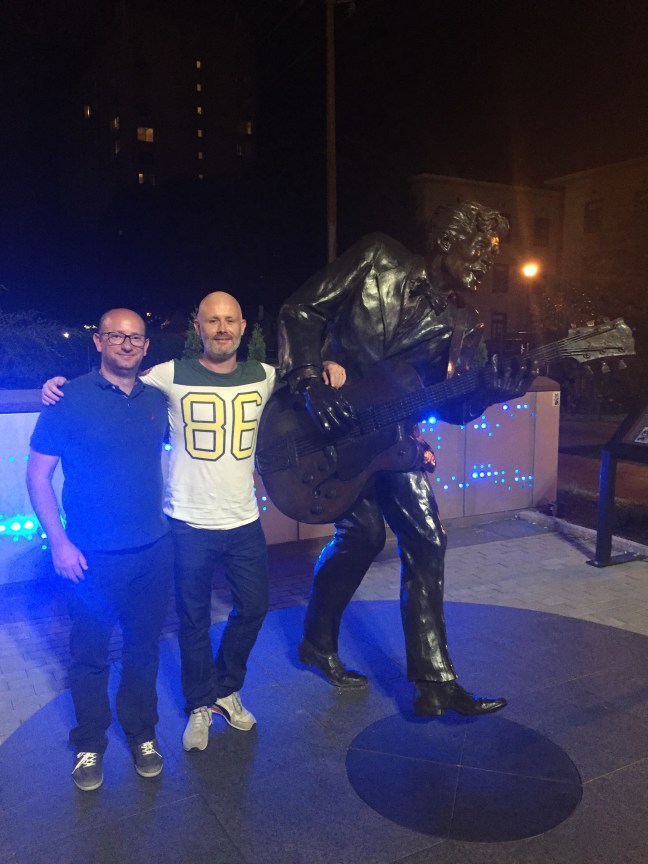
Blueberry Hill itself is worth seeing, a massive boozer festooned throughout not only with Berry paraphernalia but loads of other fine records and pop memorabilia stretching back nearly 70 years.


It’s here, on the stage downstairs, that he did his last shows, unofficially retiring in 2014 at the age of 88.
Better to remember him in his prime though. In this 1972 performance of his “Promised Land”, it’s all there: a story about a troubled journey that takes in nine states via Greyhound buses and jets, lyrics that fit absolutely perfectly with the rhythm, a playful performance that is both loose and yet totally controlled. And in exactly two minutes.
A few weeks after Voyager left Earth, Saturday Night Live did a sketch about it. The joke then was that the first radio message received from outer space was: “Send More Chuck Berry”.
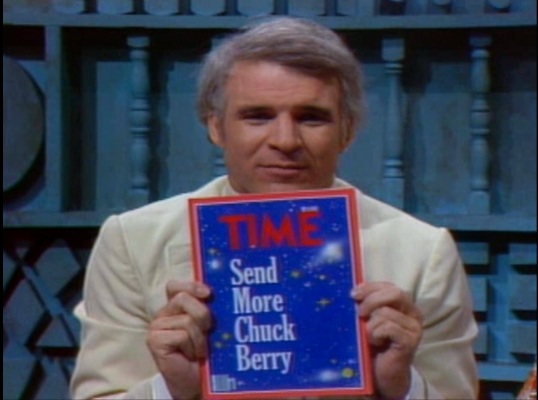
I for one welcome our alien overlords.
 snowinginspace