
Al and I spent just a few hours in St Louis on Saturday morning before heading off to Kansas. The bulk of that time was spent around the Jefferson National Expansion Memorial, which among other things marks the starting point of Lewis & Clark’s Expedition and the subsequent Louisiana Purchase in the early 1800s. The main feature is the spectacular Gateway Arch, probably now the most recognisable icon of the city, but of more interest to us (especially on a really humid morning) was the Old Courthouse.
Like many of the state or federal buildings here, it’s built in a classical style: with four distinct wings and an impressive cast-iron dome reminiscent of St Peter’s Basilica in Vatican City or St Paul’s Cathedral in London.
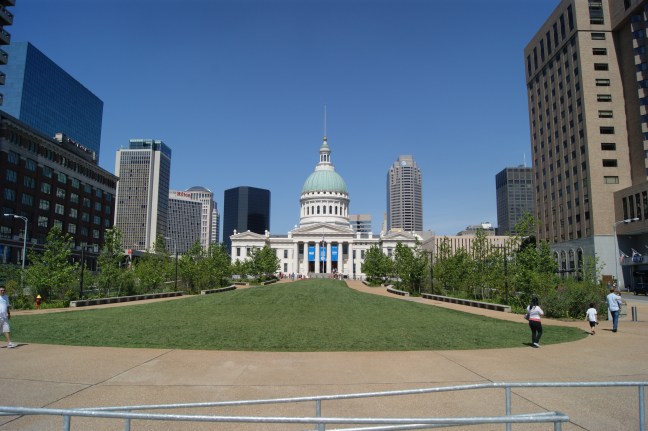
Inside that dome, in the courthouse rotunda, there is a fascinating museum setting out a useful history of St Louis and the state of Missouri more generally. Inevitably, that history very soon alights on what is a national story: the role of slavery and the battle for human rights.
At the centre of the story here is that of Dred and Harriet Scott. In 1846, they entered this Courthouse to sue Irene Emerson, who claimed to own the Scotts and their children, for their freedom. The case took 11 years to conclude, going all the way to the Supreme Court in 1857. The Court’s majority verdict – ruling against the Scotts on the grounds that since they weren’t citizens they couldn’t sue – caused outrage locally, nationally and internationally and was a major contributor to the Civil War just a few years later.
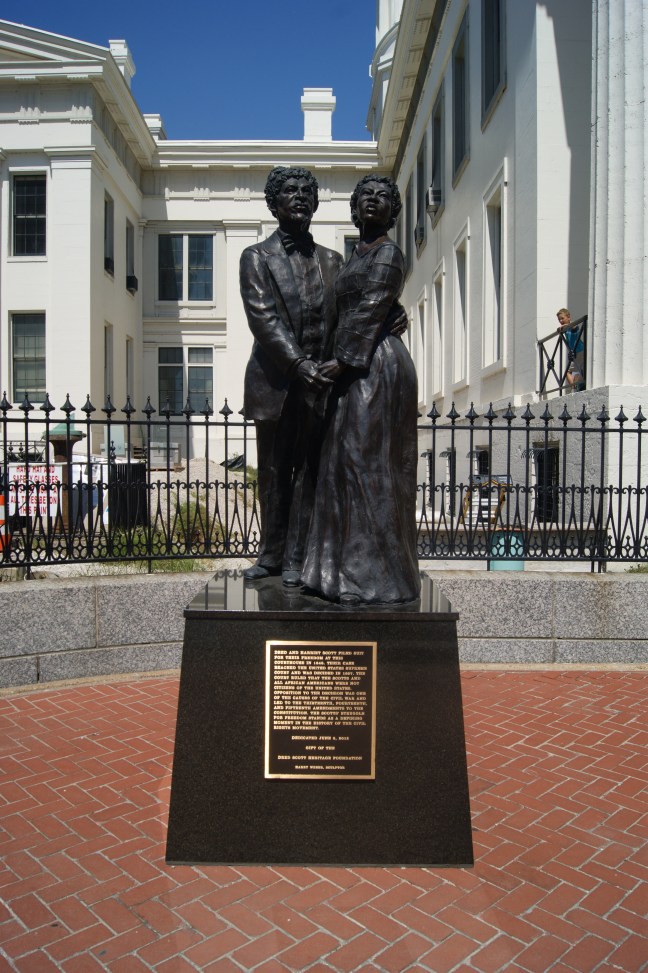
It’s a cliché to say that the fight didn’t end with the Civil War. And it didn’t end 100 years after that with the Civil Rights legislation of the 1960s. And it’s far from fixed even now. Literally just a few miles from where this statue stands is Ferguson, where in late 2014 and again in August 2015 a wave of protests and riots broke out in response to the killing of Michael Brown by Darren Wilson and the latter’s subsequent acquittal. Those events led to lengthy and heated discussions about the relationships between the (armed) Police and African Americans, the Use Of Force Doctrine locally and the significant racial disparities between the Ferguson Police Department and the people living there (a population that is two thirds black is served by a police force that is 90% white).
It’s just as clichéd and trite to say then that the US has a long way to go. But when one of the Presidential candidates in 2016 actively whips up suspicion and fear about Mexicans, other Latinos and Muslims and is painfully slow about disavowing the support of a proudly racist arsehole like David Duke (!), the worry is that it’s going backwards.
 snowinginspace