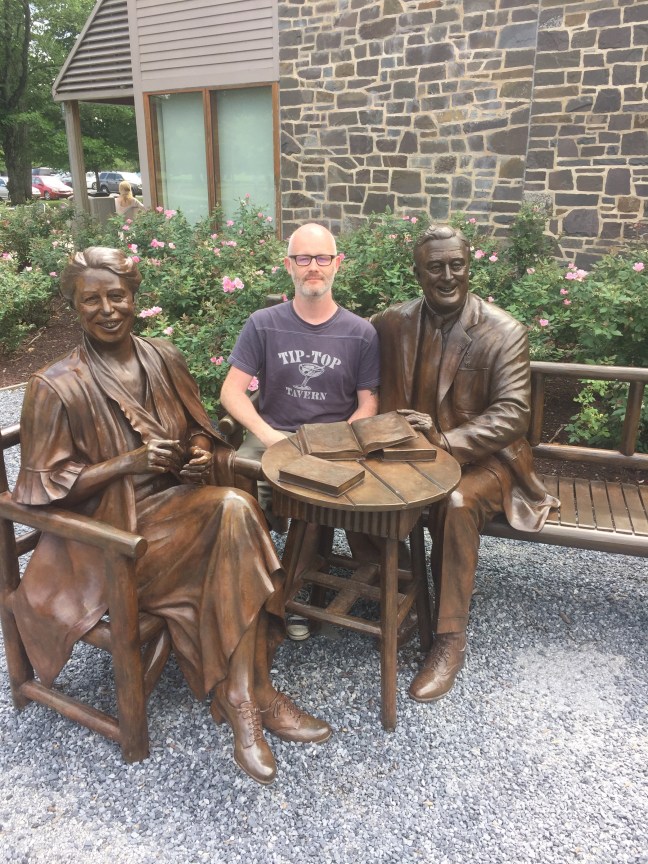
The Franklin Delano Roosevelt (FDR) Library is only an hour’s drive from the Kobzas in Wallkill; on the eastern shore of the Hudson River, on the way to Albany. This was the first of four libraries I hope to visit across the states (with Eisenhower’s in Kansas, Truman’s in Missouri and Lyndon Johnson’s in Texas to follow: I’d already visited the JFK one in Boston in 2008), and I spent a very pleasant few hours wandering through the museum, library and home of probably the last ‘great’ US President, and possibly second only to Lincoln.
I’ll maybe post some thoughts on all of the libraries at the end of the trip. But I did want to say a few things about FDR at the outset.
When I was a kid in the 80s, FDR was the only other US President (other than the then incumbent Ronald Reagan) that I was really aware of. Firstly, because he appears in ‘Going Solo’, Roald Dahl’s sort-of autobiography which I just adored growing up: Dahl, in Washington with the RAF and probably at that point a spy for the UK, had recently published a story called ‘Gremlins’ that resulted in an invitation from Eleanor Roosevelt to visit the White House and the Roosevelt‘s home.
A fictionalised version of the Roosevelts also feature in ‘Annie’, the first VHS cassette that my family owned in the mid-80s. In that film, FDR tells Daddy Warbucks and Annie about his plan for welfare programmes to help the poor, and enlists Annie to help as well. The implication is that she inspires the New Deal, one of the many incredible initiatives and achievements of his presidency.
Most people will know the song ‘Tomorrow’ from the film, which echoes FDR’s famous phrase: “we have nothing to fear but fear itself”. (In actual fact, the official Democratic Party song in 1932 and thereafter was “Happy Days Are Here Again”). Consciously or coincidentally, Bill Clinton’s campaign 60 years later borrowed from Annie and FDR, choosing Fleetwood Mac’s “Don’t Stop (Thinking About Tomorrow)” as a motif.
American politics has always struck me as being (in campaigning terms at least) much more optimistic than its equivalent in the UK.
Even in the early 1930s with the Great Depression and into the beginnings of the Second World War, FDR was relentlessly upbeat: a model of energy and dynamism and who clearly loved what he did despite being literally crippled with polio. Those who followed him – and especially the successful ones – offered similarly hopeful and confident visions. Think of JFK’s “New Frontier”, Johnson’s “Great Society” and Reagan’s “Shining City On A Hill”.
As I write this in mid July, the Republican National Convention is playing out in Cleveland, Ohio. There’s no positivity there, with a succession of senior US politicians, minor TV stars and Donald Trump himself painting a picture that is gloomy and despairing. Its undoubtedly true that things are far from great for many people in the country now but the remedies seem dystopian rather than inspiring.
 snowinginspace